Seventh-tier Wimborne Town didn't just get lucky against Crawley Town. They outworked a fourth-tier side for most of the afternoon, and the 1-0 scoreline undersells how firmly they controlled the first half. My read is that this is the kind of result that changes a small club's season, its finances and its sense of what it can become.
A result with a long memory
Wimborne's previous high point in the competition came in 1982/83, when they reached the first round proper and lost 4-0 at Aldershot. That trip still resonates. Around 1,000 supporters made the 180-mile journey to the 7,000-capacity ground known as 'The Rec', and many of them still talk about it.
Manis Canny, Wimborne's centre-forward and captain that season, was playing in the Western League Division One at the time. "Struggling to survive in the tenth tier, we were just happy to beat a Merthyr Tydfil side five divisions above us to qualify for the first round proper," he recalls. Now in his early eighties, he put the Aldershot defeat in perspective: "Aldershot were on a different level, and the 4-0 could have been expected. We were just happy to get that far."
Canny's verdict on the current side is the most telling thing he said. "The coach Tim Sills has these lads doing so well. They're in a different league to us back then. Anything is possible." Coming from a man who knows what the club has been through, that's high praise.
Money that changes the conversation
Cup income is shared between the two clubs, and the Bournemouth Echo reported an estimated £75,000 to £100,000 in potential funding from this tie. That's not a figure grassroots clubs see often. The money is earmarked largely for a new pitch, which is a sensible use. Facilities are the bottleneck for clubs at this level, and a single cup run can do more for training and matchday infrastructure than years of incremental fundraising.
The scale of the moment also explains the emotion in the clubhouse. When a League Two side came out of the draw bowl, the reaction was a mix of disbelief and loud cheering from supporters, players and coaches in the 1878 Suite. Forty-three years is long enough for a generation to forget the club was ever anything but a seventh-tier outfit.
Crawley's exit is a reminder of how fast fortunes flip in this competition. One round sends a club on a long bus ride home, and another can transform a club's year.
A ground built for nights like this
Wimborne is a market town of roughly 12 kilometres outside Bournemouth, and the 3,300 tickets for this tie sold out within hours. That demand is striking when you consider the club's population base. Few locals were untouched by the prospect of cup glory.
The Wyatt Homes Stadium, known to longtime supporters as New Cuthbury, is the product of a shrewd piece of business. The club's traditional Cuthbury Ground was sold to property developer Wyatt in 2017, and part of that deal secured land and the construction of a new stadium on the eastern edge of town. The result is a modern ground with a clubhouse capable of holding up to 400 people, bordered by a 4G training pitch. That's infrastructure built for growth, not just survival.
Chairman Tony Grant, in the role since 2018, summed up the pressure and the opportunity. "All 3,300 tickets were sold out in a matter of hours. Things have not been easy since we missed out in the play-offs to England's sixth tier in 22/23, and small clubs like us have to maximise our chances when fortune comes knocking." The live broadcast on TNT TV added another layer of exposure that the club is clearly keen to use.
Yang's goal and a first half to remember
Seung-Woo Yang, the South Korean midfielder who moved to the UK with his parents as a two-year-old and grew up in Bournemouth, was the central figure. Asked beforehand who he'd want to face in round three if Wimborne won, he didn't hesitate: "My dream is to play against Birmingham City and my idol Paik Seung-Ho." He first had to get past Crawley, and he did it in style.
Nine minutes in, Angel Diaz, the former Chile youth international, played a sharp one-two on the edge of the box with Yang. Yang's curled finish into the top-left corner left Crawley keeper Vito Mannone, a former Arsenal reserve, with no chance. Wimborne's pressing had unsettled a visiting side that looked disjointed, and the goal rewarded the approach.
The home side did not sit back after that. Crawley's manager Keith Blackwell reacted at half-time by making three changes, but the part-timers held their narrow lead into the break with a performance that belied the gap between the two clubs.
Crawley push, Wimborne hold
The second half was tense, and that's where Wimborne's defensive organisation mattered. Crawley threw bodies forward. Charlie Barker's shot came close, and Kai Jennings, on loan from AFC Wimbledon, drilled a low effort that fizzled just past the left-hand post. Crawley struggled to find clean openings, though, and the home side's individual performances narrowed the quality gap.
Former AFC Bournemouth Under-21 keeper Cameron Plain was steady behind a back line in which centre-back Sam Roberts was outstanding. Then came the moment that all but settled it. A Jackson King shot deflected off Cameron Munn and into the visitors' net with about 11 minutes to play. Crawley were given nine minutes of added time, but the scoreline never really wobbled.
The final whistle set off scenes of pure joy. Wimborne have not lifted a trophy since their FA Vase win in 1992, and this was the biggest afternoon in their history. The pitch invasion that followed was large but good-natured, which says plenty about the relationship between this club and its town.
Two sides of the same afternoon
Yang, who had already been through five press interviews, was almost lost for words. "I have never scored a goal like that before in my life, but what better day for it?" The 24-year-old property surveyor added: "It was a really tough game, but we carried out the game plan to a T. We had to, because of the quality of the opposition. Right now there is just no better feeling."
Crawley captain Jude Arthurs, the former Gillingham midfielder, was more subdued. Standing in the centre circle long after the whistle, he was candid: "We just weren't good enough. We knew they would throw it all at us, and they did." He was also gracious. "I've played at this level and I know how much a win like this can mean. The crowd here were intimidating, credit where credit is due, but we were poor."
The draw and what comes next
The celebrations carried into the next day. Around 300 fans, staff and sponsors packed the clubhouse for the round-two draw, and the mood turned to euphoria when former Stoke City goalkeeper Asmir Begovic pulled out ball number 29 and matched it with ball number 35. Bradford City, one-time FA Cup winners, were the opponents.
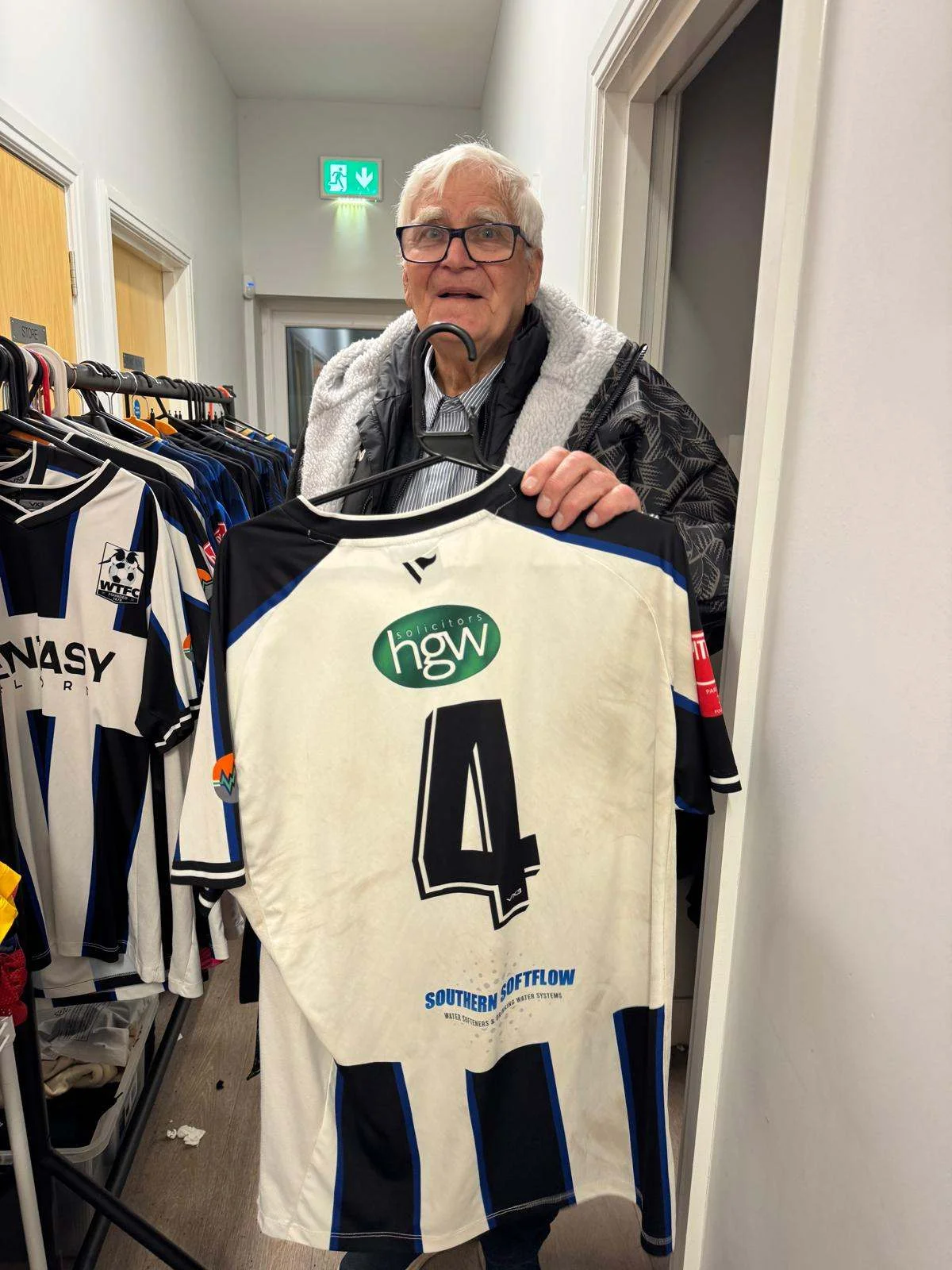
Jeff Robbins (photo by Ben McFadyean)
Jeff Robbins, the club's 78-year-old kitman and mascot, has been with Wimborne since 1997 and captured the feeling in the room. "Over the years I've seen many managers come and go, but it's never been quite like this. We are doing so well in the league, and now Bradford. All credit to general manager Jimmy Glass and manager Tim Sills, we will be well up for it."
Round two is on December 4th, and it will be the biggest payday in the club's history. Bradford is a far tougher prospect than Crawley, but Wimborne have shown they can press, defend and finish when it counts. My take is that the real test is whether they can keep that identity against opponents with more experience at this level. If they do, the club's long-term plans look a lot more achievable.