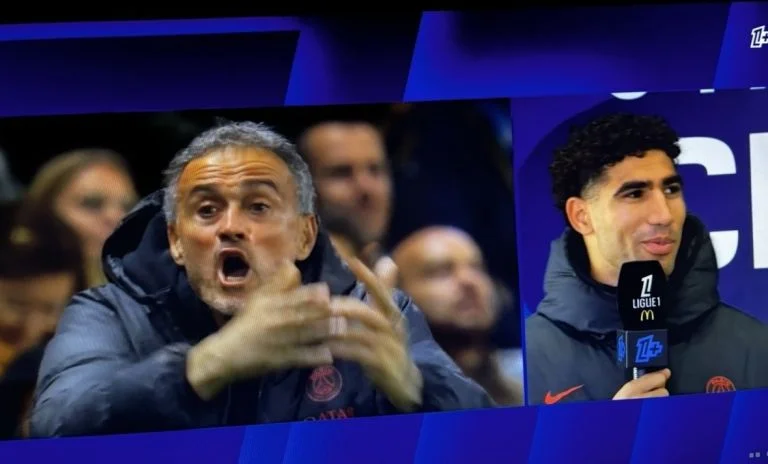
Achraf Hakimi had a hand in all five of Paris Saint-Germain’s goals in Friday’s 5-1 win over Le Havre, scoring three times and providing two assists. That kind of contribution is hard to reduce to a single role: Hakimi was operating from the right wing-back position, but his movement repeatedly carried him into areas usually associated with a forward. The performance also offered a glimpse of the attacking freedom Luis Enrique gives him—and of a small misunderstanding between the two.
Hakimi’s freedom to attack
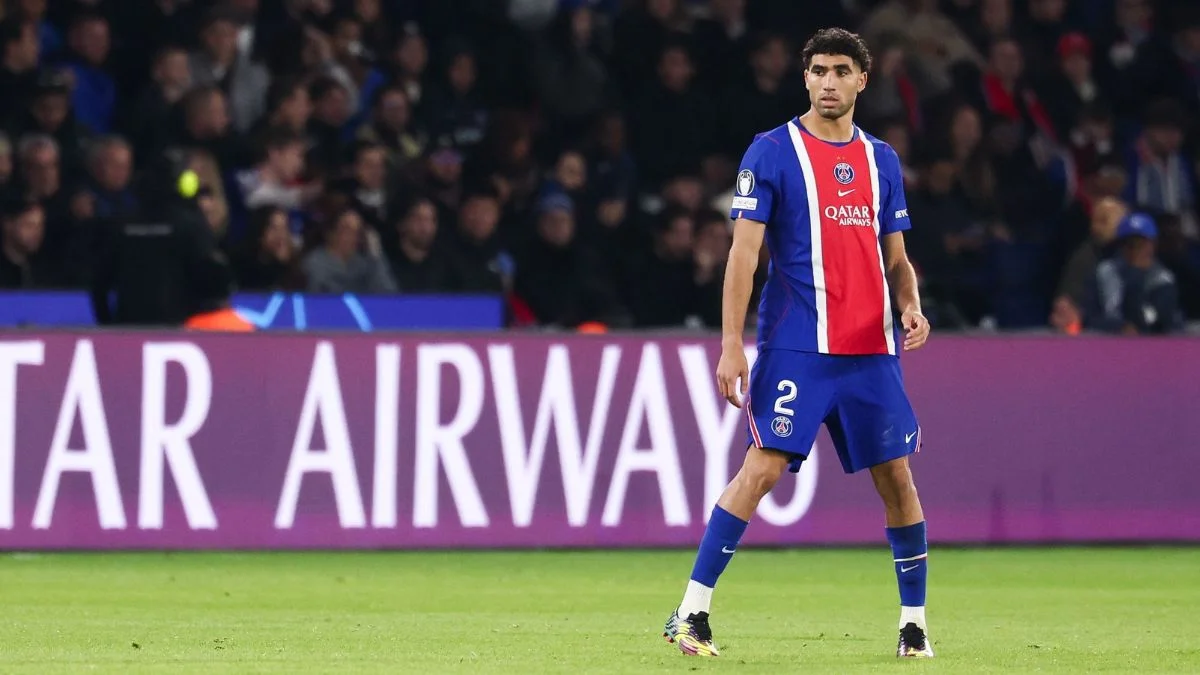
Hakimi described the comfort he feels alongside his PSG teammates when speaking to Canal Plus: “I feel comfortable playing with these teammates, we know each other inside out, we’re having a blast!” His explanation points to familiarity as part of the picture. In a team where players are expected to combine quickly and cover changing positions, knowing how teammates move can help make an aggressive run feel less like a gamble.
His forward runs took him into the penalty area, where he finished like a striker. “From time to time, I move like a number 9, I finish my actions like a number 9. It’s the coach who gives us those freedoms!” he said. The distinction matters: Hakimi’s attacking presence wasn’t simply an individual decision to abandon his position. He credited Enrique with giving players room to make those choices, suggesting the system is designed to let him contribute closer to goal when the situation allows.
This is more significant than it looks. A wing-back who can arrive in the box creates another attacking option, but that freedom also depends on the rest of the side maintaining enough structure to cover the spaces he leaves. The match account doesn’t explain exactly how PSG managed those responsibilities, so one performance can’t establish how the balance works in every game. Still, three goals and two assists make a persuasive case that Hakimi’s movement had a major effect on this result.
And there’s a useful reminder in his “number 9” description: positions on a team sheet don’t always describe where a player will make the decisive contribution. If you’re working in this space, the question is less whether Hakimi is a defender or an attacker than how PSG can create room for his runs without losing their shape. That’s a tactical trade-off, not a label.
Why Enrique confronted him
Enrique was seen speaking sharply to Hakimi after one of his goals. Hakimi said the coach believed he was disputing a decision with the referee. He was actually checking whether the goal would stand for offside. The explanation turns what looked like a disagreement into a brief misread of a conversation, though it also fits Hakimi’s admission that he often speaks with officials.
“The coach thought I was arguing with the referee. It’s true that I usually talk a lot with referees, but this time, it was just to ask if my goal was offside. It wasn’t bad faith!” Hakimi told Canal Plus. That clarification is simple, but it gives the moment a little texture: a coach saw what he thought was a familiar argument, while the player says he was seeking a quick answer about the validity of his goal.
Here’s the thing: the exchange doesn’t need to become a story about a fractured relationship. The available account offers a plausible, ordinary explanation for the tension—Enrique misunderstood what Hakimi was asking. A sharp word on the touchline can look dramatic from a distance, especially in the immediate aftermath of a goal. In this case, Hakimi’s own account makes the moment seem smaller than the images might suggest.
(And this is the part most people overlook.) The misunderstanding also shows how quickly a coach may react when a player appears focused on an official during a match. Hakimi says he wasn’t arguing in this instance, but he acknowledges that he does talk to referees frequently. That detail gives Enrique’s assumption some context without proving what he was thinking beyond Hakimi’s description.
What the performance means for PSG
Hakimi’s performance was central to PSG’s win, while his explanation suggests the exchange came down to a quick misread of his conversation with the official. The two details belong together: one is about how much responsibility he carried in attack, and the other is a small glimpse of the communication around him. Neither, by itself, tells the full story of PSG’s season or Enrique’s wider approach.
What this means for you as a reader is that the strongest takeaway is concrete: Hakimi contributed directly to every PSG goal against Le Havre, and he says his coach gives him permission to attack with the instincts of a striker. Whether that level of involvement is repeatable will depend on the match and the team’s needs. A five-goal contribution is an emphatic result, but it isn’t a guarantee of the same output in future fixtures.
That said, Hakimi’s comments offer a clear view of how he understands his role. He feels comfortable with his teammates, sees his forward movement as part of the freedom Enrique grants, and says the apparent argument with the referee was only a question about offside. A productive night, then, with one moment of confusion at the edge of it.
PSG are also preparing a new contract offer for one of their main stars, though he’s in no rush to sign. The contract detail adds another strand to the story, but the available information doesn’t establish how the offer will develop. For now, Hakimi’s display on the pitch is the clearest evidence of his importance to PSG, while his comments suggest he’s comfortable with the freedom he’s been given.