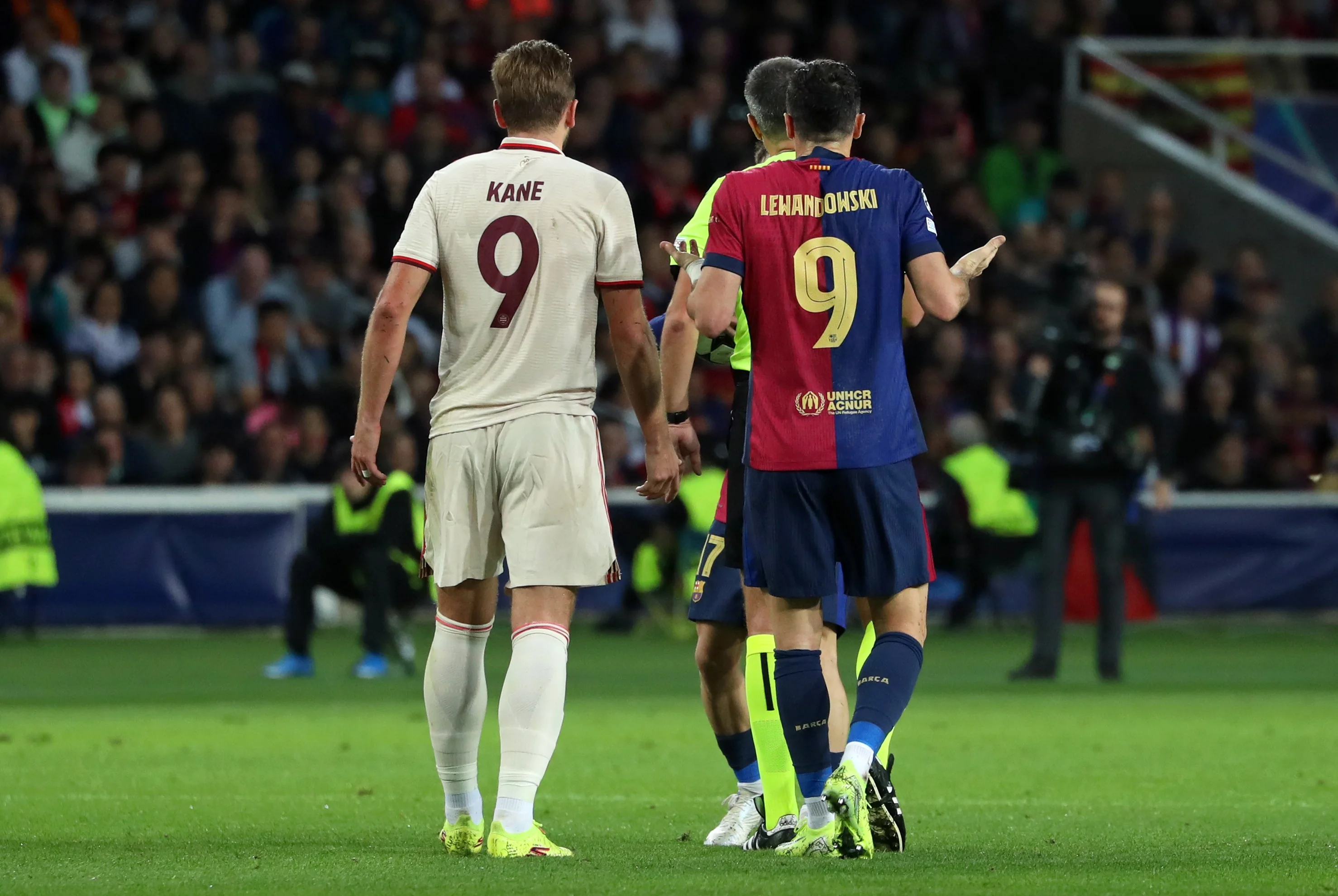
Two different definitions of a striker
Choosing between Harry Kane and Robert Lewandowski at their Bayern Munich peaks comes down to what a team needs from its striker. Both scored at an extraordinary rate, but they shaped the attack in different ways. The comparison is less about deciding which forward has the more impressive highlight reel and more about how each one affects the players around him.
A striker is often judged first by goals, and for good reason: putting the ball in the net is the job’s most visible measure. But a centre-forward can also influence where teammates receive the ball, how defenders are occupied and whether an attack has a reliable route forward when space is tight. Those contributions don’t always show up in a season’s headline total. They still matter to a team’s shape and rhythm.
Lewandowski’s case rests on relentless finishing, sharp movement and remarkable consistency. In 2020/21, he scored 41 Bundesliga goals, breaking Gerd Müller’s long-standing record for a single season. His dominance made him one of football’s most feared forwards. That record gives the debate a hard statistical anchor: any assessment of peak Bayern striking has to reckon with a season in which Lewandowski converted chances at a historic rate.
His movement helps explain why that output carried such force. A forward who finds space at the right moment can turn a promising attack into a clear chance, even when he’s touched the ball only briefly. The threat also changes how defenders approach the rest of the team. They have to account for the possibility that a pass into the area will become a shot before they can reset. Lewandowski’s profile, as presented here, is built around making that final action count again and again.
Lewandowski’s case: the finishing standard
Consistency is a different test from a single remarkable run. A prolific striker has to keep producing while opponents adjust, chances vary in quality and the team’s attacking patterns shift. Lewandowski’s reputation in this account rests on both frequency and repeatability: his finishing wasn’t simply a useful feature of the Bayern attack; it was the central threat opponents had to contain.
That can make a team’s choices simpler. When a forward is a dependable end point, teammates can focus on delivering the ball into dangerous areas and trust that the move has a capable finisher at its end. Simpler doesn’t mean easy. The striker still needs timing, positioning and composure, while the team must create enough opportunities for those qualities to matter.
The 41-goal season is an exceptional benchmark, but one season can’t answer every question about a forward’s value. A scoring record tells you how often a player finished; it doesn’t, by itself, describe how he helped build the chances, drew defenders away or connected midfield to attack. That distinction matters in a comparison with Kane, whose broader role is the defining part of his case.
Kane’s case: creating as well as scoring
Kane offers a broader attacking role. Alongside top-level finishing, he links play, creates chances and uses his passing to bring teammates into the game. His Ballon d’Or win adds another distinction to a career already marked by exceptional production. Where Lewandowski’s profile here centres on the devastating finish, Kane’s includes more of the work that can happen before a shot is taken.
Link play gives a forward another way to shape an attack. By receiving the ball and finding a teammate, a striker can help the team move through pressure or set up a different player to finish. That doesn’t make goals less important. It changes the routes by which a team can create them, and can make the forward a passing option as well as the final target.
Kane’s passing also raises a tactical question: should the striker stay close to goal, or move into areas where he can help organise the next phase of an attack? There’s no universal answer. The right choice depends on the surrounding players, the space available and the team’s preferred way of advancing the ball. A forward who can contribute in both roles gives a coach more ways to structure an attack, though the benefit depends on teammates being ready to use the space and passes he creates.
That flexibility has a practical value beyond a list of skills. If defenders focus on stopping Kane from finishing, his passing can still bring others into the move. If they close down his options to pass, he remains a goal threat. This is more significant than it looks: the pressure he creates can influence the shape of a defence even when he doesn’t take the final shot.
What the comparison tells us about Bayern
Here's the thing: Lewandowski’s record season sets a formidable standard, while Kane’s ability to create as well as score gives Bayern a different kind of threat. That’s the clearest distinction between them in this comparison. One profile puts historic finishing at the centre; the other offers a forward who can contribute both as a scorer and as a facilitator.
For a team, the choice depends partly on what its attack already has. If the supporting players can create chances and the main requirement is a high-volume finisher, Lewandowski’s case is especially compelling. If the side needs its striker to help connect the attack and create openings for teammates, Kane’s broader role may be more useful. Neither description settles the debate in every match or system. It identifies the trade-off a coach would be weighing.
(and this is the part most people overlook) A striker’s individual output can’t be separated neatly from the structure around him. The quality and type of service, the runs made by teammates and the space opponents leave all affect what a forward can do. Comparing the two at their peaks is still valuable, but the answer changes with the team’s needs. A record total and a broader passing role are different strengths, not interchangeable measures.
There’s also a difference between asking who had the more extraordinary season and asking who offers the more varied attacking contribution. On the first question, Lewandowski’s 41-goal Bundesliga campaign gives him a powerful claim. On the second, Kane’s combination of finishing, link play and chance creation makes his argument. The source of the debate is precisely that the evidence points to different kinds of value.
The implications for choosing a peak striker
If you're working in this space, the useful question isn’t only which player scored more. It’s what the team needs from the position. A side seeking a decisive finisher may prize Lewandowski’s record and movement; a side that wants its centre-forward to help create chances may value Kane’s passing and link play. The preferred answer will reflect the team’s priorities as much as its view of either player.
And yet, comparisons like this shouldn’t turn a tactical distinction into a claim that one player was simply complete and the other wasn’t. The available description makes a case for two different strengths. It doesn’t give enough detail to rank every aspect of their play or establish which profile would suit every Bayern side. A fair judgment has to stay within that boundary.
What this means for you as a reader is that the choice can be both clear and unresolved. Lewandowski’s record season is a striking measure of finishing; Kane’s broader contribution offers another model of a striker’s influence. If the question is who set the sharper scoring benchmark, Lewandowski’s case is hard to ignore. If it’s who could do more to involve teammates while still threatening to score, Kane has the stronger argument in this account.
Two elite forwards, two different answers to the same tactical problem. That’s the debate’s appeal—and its limit. Which version of a peak Bayern striker would you choose?
Join the conversation!
Sign up for a user account and get:
- New, improved notifications system!
- Fewer ads
- Create community posts
- Comment on articles, community posts
- Rec comments, community posts