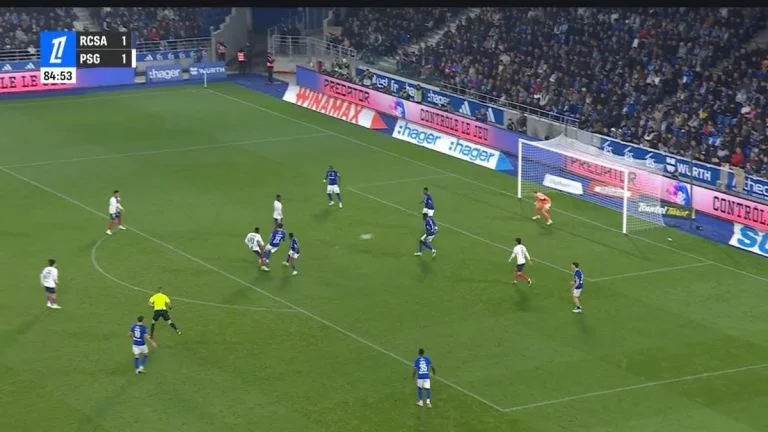
Paris Saint-Germain’s heavily rotated lineup spent much of Saturday’s visit to Strasbourg looking short of control. The hosts took a first-half lead, created further chances after the break, and had reason to think the result was within reach. Then PSG scored three times late to turn a 1-0 deficit into a 3-1 win in Alsace. The change in scoreline was sharp; the performance that preceded it was less reassuring.
Luis Enrique’s selection carried an obvious trade-off: several key starters got a rest, but the reshaped side had to find its rhythm under pressure. For a long stretch, it didn’t look as though PSG had found it. Strasbourg’s lead and subsequent chances exposed the risk of rotation when the players coming in haven’t yet settled into the same patterns. Still, the late comeback meant the coach got both the points and the rest he wanted. That’s a useful outcome, though the closing score shouldn’t erase how much the match asked of PSG before it arrived.
Strasbourg make PSG work
Gio Reyna opened the scoring with a near-post effort that took a decisive deflection and beat Matvey Safonov. The deflection mattered: it changed the ball’s path and made the save more difficult. Even so, the goal put PSG in a position where it needed to respond, and Strasbourg were able to keep testing the visitors rather than simply defend their advantage.
The hosts had opportunities to extend their lead after the break. Conrad Harder’s header forced Safonov into a save, and Reyna sent the rebound over the bar. Harder then tested the goalkeeper again from a tight angle in the 66th minute. None of those chances became a second goal, but together they show why the match remained uncomfortable for PSG deep into the second half.
That stretch is easy to lose sight of when a match ends with a two-goal margin. Strasbourg weren’t merely hanging on to a narrow lead; they were still finding ways to threaten. PSG, meanwhile, needed its goalkeeper to keep the deficit at one. The gap between surviving a difficult spell and taking control of a match can be thin. On Saturday, PSG crossed it late.
Three goals change the finish
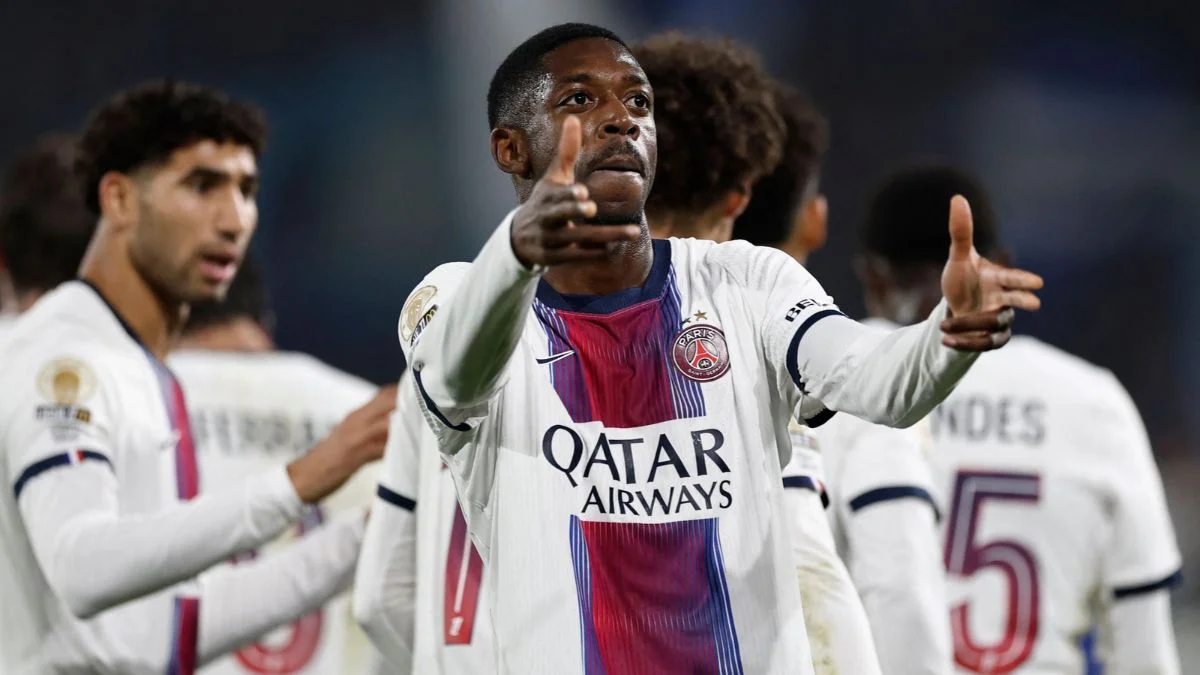
PSG’s equalizer came after the visitors were awarded a penalty, but Ousmane Dembélé missed it. A missed spot kick can drain momentum from a team chasing the game, especially when the score is still against it. PSG avoided that outcome. Four minutes later, in the 76th minute, Dembélé sent in a cross that Ilya Zabarnyi converted to make it 1-1.
The equalizer changed the immediate problem for both sides: PSG no longer had to chase, while Strasbourg had to protect a draw after spending much of the match ahead. Dembélé’s next contribution went further. In the 85th minute, he collected a loose ball and scored from range for his first Ligue 1 goal of the season, putting PSG in front. The turnaround came from two different kinds of contribution: a delivery that produced the equalizer, followed by a finish that supplied the lead.
Ferran Torres set up Désiré Doué for PSG’s third in stoppage time. That goal settled the score at 3-1, but the late sequence shouldn’t be mistaken for ninety minutes of command. PSG had been trailing, Dembélé had missed a penalty, and Strasbourg had threatened to score again. The finish was decisive. The route there was anything but smooth.
Rotation in focus
Luis Enrique made extensive changes, with Marquinhos left out as part of the coach’s rotation policy. Maghnes Akliouche started, and his manager has praised his progress. The available facts don’t establish that any single selection caused PSG’s early difficulties, but the match makes the cost of changing a lineup visible: a side can preserve energy for key starters and still lose cohesion in the short term.
Here’s the thing: rotation is a practical tool over a season, but a changed lineup still has to perform in the match in front of it. PSG’s late response made the selection gamble look far less costly, because the team recovered the lead and held on for the win. It didn’t make the vulnerable spell disappear. (And this is the part most people overlook.) Rest only pays off if the players who come in can manage the minutes they’re given.
This is more significant than it looks. A late win can show that a squad has enough options to produce decisive moments even when the opening plan falters. It can also leave questions about how well those options work together before the game turns. For PSG, Saturday supplied evidence of both: the rotated side was exposed to danger, then found a way to change the result through Dembélé’s delivery and goal, Zabarnyi’s finish, and Torres and Doué’s late combination.
What the result says
If you’re working in this space, the match offers a familiar lesson about reading results: the final score answers who won, but not how comfortably the team controlled the contest. PSG did secure the outcome Luis Enrique needed from a day of extensive changes. Strasbourg, though, created enough danger to show that the victory depended on a late recovery rather than steady dominance.
That said, the recovery counts. PSG turned a deficit into a two-goal win, and the key starters who were rested remained out of the starting lineup. The open question is whether the late scoring reflects a repeatable response from the reshaped side or a solution specific to this match. One result can’t settle that. For now, PSG have the points and the rest they sought; the uneven performance is the part to watch in future rotation decisions.
The match highlights are in the video below:
Rotation in focus
Luis Enrique’s changes nearly cost PSG points, but the late response changed the reading of the day. Marquinhos was left out under the coach’s rotation policy, while Akliouche started after his manager had praised his progress. The result gives the selection a successful outcome, though the match itself was a reminder that fresh legs don’t guarantee an easy afternoon. PSG needed a penalty miss, an equalizer, a long-range goal, and a stoppage-time finish before the scoreline looked comfortable.